Wednesday, November 13, 2013

Crash Hot Potatoes from Pioneer Women

This recipe is a favorite in our family.  We eat it all the time.  Just this last week we ate it twice.  I love getting new potatoes (baby reds) and making this dish with them.  My kids easily eat the entire pan.  All of my siblings love this recipe as well as their kids.  What amazes me is how easy the recipe is and how few ingredients you actually use.   This recipe comes from The Pioneer Woman.  This woman is the goddess of cooking warm and hearty dishes.  She rarely makes anything that isn't amazing.  When I look at potatoes now I actually crave these.  We love to eat them just as they are or with a bit of sour cream.  I promise once you make and try these you won't ever want to eat potatoes differently again.


Crash Hot Potatoes from The Pioneer Woman

 Ingredients

  • 12 whole New Potatoes (or Other Small Round Potatoes)
  • 3 Tablespoons Olive Oil
  • Kosher Salt To Taste
  • Black Pepper To Taste
  • Rosemary (or Other Herbs Of Choice) To Taste

Preparation Instructions
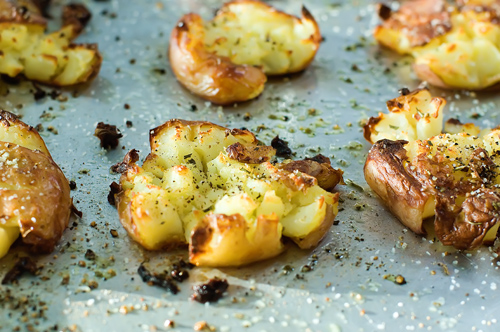
DSC_0051_6300Bring a pot of salted water to a boil. Add in as many potatoes as you wish to make and cook them until they are fork-tender.
On a sheet pan, generously drizzle olive oil. Place tender potatoes on the cookie sheet leaving plenty of room between each potato.
With a potato masher, gently press down each potato until it slightly mashes, rotate the potato masher 90 degrees and mash again. Brush the tops of each crushed potato generously with more olive oil.
Sprinkle potatoes with kosher salt, fresh ground black pepper and fresh chopped rosemary (or chives or thyme or whatever herb you have available.)
Bake in a 450 degree oven for 20-25 minutes until golden brown. Serves 6.

Note: The Pioneer Woman uses fresh rosemary.  I never have fresh so I just used dried and it still tastes amazing.  I also recently broke my potato masher so I just use a fork.  It causes the potatoes to smash down a little more but it also helps them get brown faster.

Recipe and Photo comes from the blog The Pioneer Women

Tuesday, November 12, 2013

7 Steps to Heal Your Back Pain: Faulty Medical Advice Is Making Us Worse

by Steve Ozanich, author of The Great Pain Deception 


I was in pain for 27 years until I discovered that my pain wasn't coming from my body's structure. Since then, I've been helping thousands of people become pain-free by teaching them how pain comes from tension—not a failing body. Almost every one of those people was told by their physicians that they needed immediate disc surgery, or steroid injections, or therapy, or rest, or this and that—but not one of them did. They all healed with new knowledge. But they had to accept the fact that their bodies were ok, and resume all normal physical activity, without fear. The truth set them free—and it began with understanding certain basic things.

1)    Get a Physical Exam: Make sure there is no pathological process occurring—take responsibility for your health.

2)    Take Your Physical Exam Results with a Grain of Salt: If your exam shows only herniated discs, arthritis as seen on the x-ray, spurs, a crooked spine, spinal narrowing (stenosis), or any other normal change, be of great cheer! These things do not cause back pain. No matter how much doctors confuse people in this area, experience has shown that these things are simply there—most people have these anatomical changes, with or without pain. Pain comes from oxygen loss. Whether the pain is in the limbs or spine or any other area, it rarely ever comes from the body's-structure. It's almost always the effect of tension, or TMS: Tension Myoneural Syndrome.

3)    Reject the Multi-Disciplinary Approach: This approach basically says, "We don't have a clue what to do for your pain, so let's try everything, and hope one works." This includes acupuncture, spinal manipulations, surgery, injections, core strengthening, losing weight, etc. These are almost always placebo-treatments, and can paradoxically keep you in pain. If they worked for a sufferer, it's because that person believed it worked. But the relief never lasts and the approach normally must be continued in perpetuity because the pain is not coming from a "failing spine." The multi-approach is a major reason for ongoing pain epidemics. Never manage pain—eliminate it!

4)    Beware of Faulty Diagnoses: Herniated discs do not cause back pain. That myth was exposed decades ago with the seminal work of pioneering pain-physician John E. Sarno, MD, who coined the acronym TMS. Spinal surgeons are just now beginning to realize that Sarno was correct. You cannot pinch a nerve or paralysis will quickly follow, and the pain will stop. A dead nerve cannot transmit pain signals.
You cannot "throw your back out." Spinal discs are firmly attached on both sides of the spine; they cannot slip in-and-out of place.
You don't have to strengthen your body's core to heal, and scoliosis does not cause pain.
The proof is in the fact that almost everyone heals if they can get past these archaic myths. The body's structure can be injured, and that will indeed cause pain. But the body heals quickly afterward. Pain does not become chronic without an emotional and/or conditioned-response process driving it.

5)    Understand the Reason for Your Pain: Almost all pain is a diversion by the brain to rivet the sufferer's attention to his body. It arises from a hidden emotional process, mainly anger, fear, sorrow, and frustration. When these powerful emotions hit a certain threshold, the brain will reduce oxygen flow to a body-area to create a diversion—as a favor—to avoid having to sense emotional pain. The pain is never imagined or faked; it is very real, and extremely painful.

6)    Look at What's Going on in Your Life: Almost everyone I've helped to heal was able to trace their pain back to an event or a life-plateau. Is your marriage in trouble? Does your job stress you out? Did a loved one die or is someone sick? Did you recently retire? Do you have the Type-T "pain personality" of perfectionism; trying to please everyone? Do you show little emotion? Did you feel abandoned as a child? Are you hyper-responsible, or a worrier? Did you just hit a milestone age? Connect the dots to your pain, and heal. The knowledge of what is occurring—at the unconscious level—has tremendous healing power because once the lid is blown off of the brain's strategy, the pain has no more value as a diversion.

7)    Try to Understand Why You Need to Believe You Have a Bad Back: If I tell someone there is a method to heal their pain forever, they more often say, "No!... my pain is real!!" Well, the pain is always real. The more important question is, when someone is told they can heal, why isn't their first question about how to do it? Why would someone fight to remain in pain? This is critical in understanding pain's purpose. The most common reason for pain is to bury emotions that are too powerful, or too dangerous. The brain creates the horrible sensation of pain to firmly "convince the sufferer" that she has a structural problem in order to divert her attention from her anxiety. So, of course she wants to believe she has a structural problem. That's her brain's intent!

Some sufferers react with extreme rage, and sometimes violence, at the notion that their pain is actually a mindbody effect. They often spit, throw things, or stomp out of the room knocking things over in rage. They only hear, "Your pain is all in your head." But this is never true; no one is saying that, the pain is very real. But it comes from something called TMS: not from all the things that most doctors are currently telling their patients. The reason people react in a hostile manner is due to the very reason they have the pain in the first place, to avoid facing something. By rejecting the truth, that their symptoms are created by internal forces, they fall right into their brain's ingenious strategy of deceit, and their suffering continues.

Modern science, in its futile efforts to outsmart Mother-nature is the leading cause of continuing pain epidemics, from fibromyalgia to chronic fatigue. The truth of healing is up against a multi-trillion dollar juggernaut called the "medical industry" that is hell-bent on continually treating pain, not healing it. The message of "how to heal" gets blocked at every turn by people inside the industry that profit from treating the body; and by publications that depend on advertisement dollars from the industry. Thus, pain epidemics are on the rise—despite possessing the most advanced medical techniques in the history of humankind.

Anyone can heal, if they can put aside all the archaic notions of pain, and begin again, with a deeper understanding. But—do sufferers want to heal... or just treat their body? The two are almost always conflicting goals.


Steve Ozanich, a mindbody health consultant, penned The Great Pain Deception based on his own experience, the work of John E. Sarno, MD, and over 12 years of intensive research. Over the years, Ozanich has helped to heal hundreds, possibly even thousands, of people. In addition to being a mindbody health consultant, the Ohio-based Ozanich is a certified personal fitness trainer, electronic engineer, and yoga instructor. www.PainDeception.com Twitter: @ SteveOzanich. The Great Pain Deception can be purchased from www.Amazon.com, www.BarnesandNoble.com, and www.PainDeception.com.

Monday, November 11, 2013

Harvest Meat 'bulbs'

This recipe is an absolute favorite in our entire family.  We grew up eating it and now our children love this recipe.  This is one of my husband's favorite recipes.  He will come home and immediately knows what I have made because of the smell.  This meal is a great hearty meal with the sweet and sour combination.  The fruit may seem strange in it but it is one of my favorite parts of the dinner.  When Nectarines and peaches are ripe this dish becomes even more wonderful.. It reminds me so much of fall, but we eat it all year long because it is too good not to.  It is a true southern dish.   We hope this recipe will become a favorite in your home as much as it has been in ours.

Recipe and photo posted by Heidi G.


Harvest Meat 'bulbs'

Meatballs:
1 egg, beaten
¼ cup milk
1 slice bread, crumbled
¼ cup chopped onion or ½ tsp. onion powder
½ tsp. salt
¼ tsp. ground cinnamon
1 lb. ground beef

Mix ingredients well in bowl and form into golf ball size meatballs. Bake in oven, uncovered, at 350°F for 30 minutes, or microwave on HIGH for 13 minutes.

Rice:
In a saucepan combine:
1½ cup rice
3 cup chicken broth (or 3 cup water with 4 bouillon cubes)
¼ cup snipped parsley
½ tsp. ground cinnamon

Cover and simmer till rice is done

Fruit Mixture/Sauce:
In another saucepan:
Melt ½ cup butter or margarine
Add ½ cup brown sugar
Add 3-4 cups of desired fruit
(Fruit can be apples, nectarines, peaches, grapes (cut in half), or cantaloupe. Soft melons do not work well. Cut the fruit into small pieces (i.e. apples, nectarines, and peaches cut into quarters and then halved, cantaloupes cut into chunks, etc.).

Cook fruit mixture for 2 to 3 minutes.

Blend in separate bowl:
2 tablespoons cornstarch
½ cup cold water
½ cup lemon juice

Stir into fruit mixture. Cook until thick and bubbly.

Add meat balls to fruit mixture sauce and serve over rice.

YEILD: 4-5 servings.
 

Note: I always one and a half the sauce because it is so good!

To make this gluten-free just substitute the bread for gluten-free bread or even gluten-free oatmeal.  I always prefer the bread but either one works

Depression may cause loss of memory details, according to BYU study

Depression may cause an inability to see differences

Depression has been linked to memory impairment, but it doesn't affect all types of memory the same way. A new study suggests that people with depression can remember the big picture, but have difficulty recalling fine details.

Brigham Young University professor Brock Kirwan and one of his former grad students, D.J. Shelton, set up a memory test where participants were asked to look at various objects that popped up on a computer screen, and mark them as a new object (something they hadn't seen in the test already) or an old object (that they had seen). Out of 83 participants, those who were more depressed (assessed by pre-study surveys) could usually tell the difference between objects they had or hadn't seen before, but were significantly more likely to categorize objects that looked similar, but not exactly the same, as "old."

“They don’t have amnesia,” according to Kirwan. “They are just missing the details.”

Difficulty distinguishing between details could be because depressed people have smaller hippocampi--the hippocampus being a vital brain region for memory processing. Some of Kirwan's previous work has connected the hippocampus to pattern separation abilities. During depression, the researchers hypothesize that the brain seems to stop producing new neurons in the hippocampus, in turn affecting pattern separation abilities.

Because the study didn't use people with a clinical diagnosis of depression, and the average level of depression in their participant pool was fairly mild, it's hard to establish direct causation between depression, neurogenesis and pattern separation abilities.  (The researchers ruled out 15 participants from their dataset for antidepressant use, since it has been suggested to increase neurogenesis, the creation of neurons.) Future studies will be needed.

The study is in the November 1 issue of Behavioral Brain Research